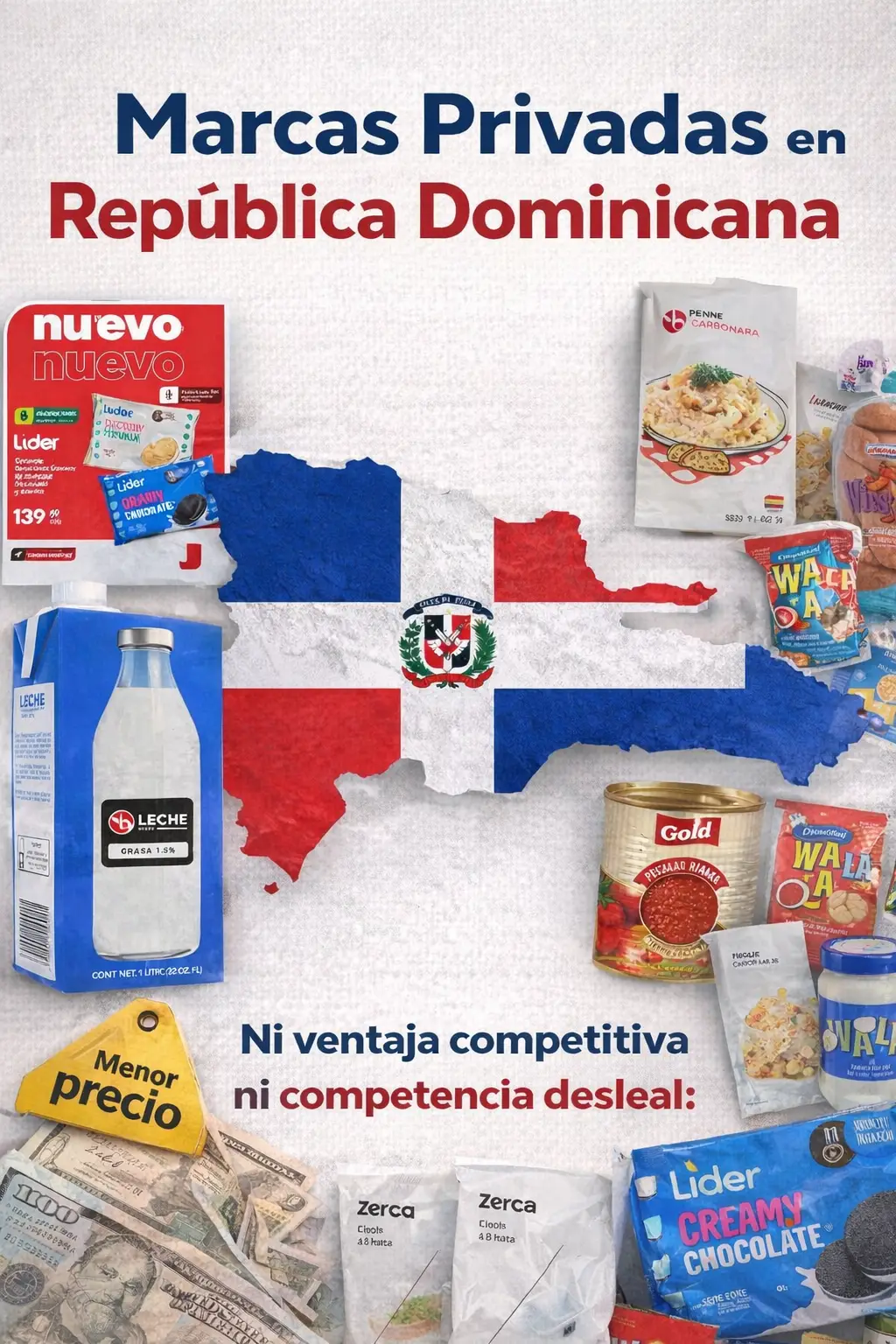

In recent days, there has been considerable discussion on social media following the announcement that a Dominican industrial bakery company will stop supplying its products to Supermercados Bravo.
The conversation quickly turned controversial.
Some claimed there was pressure to manufacture private label products, others spoke about unfair competition or conflicts between manufacturers and supermarkets.
However, from an industry perspective, the reality is much simpler:
this is not an anomaly.
It is simply modern retail at work.
First: let’s add some context
A private label product is manufactured by one company but sold under a retailer’s brand.
This is not new.
In fact, in many cases the same manufacturer that produces a well-known brand may also produce the retailer’s private label product.
The difference is not always about quality.
Often, it comes down to commercial strategy, marketing, or cost structure.
Second: why supermarkets develop private label products
The reasons are quite straightforward:
• they allow retailers to offer more affordable prices to consumers
• they generate higher margins for the retailer
• they enable faster product launches
• they strengthen the retailer’s brand identity
That is why this model has expanded worldwide.
In countries such as Spain or the Netherlands, private label products can represent more than 40% of the market in certain categories.
Third: something that is often overlooked in this debate
In the Dominican Republic, the leading retail groups already have their own capabilities to develop high-volume staple products, including industrial bakery.
For example:
• Supermercados Bravo
• Centro Cuesta Nacional (an organization where I also had the privilege of being part of the team)
• Grupo Ramos
• Plaza Lama
All of them have developed, to varying degrees, their own production facilities or industrial partnerships to manufacture key product categories.
Therefore, assuming that private label development depends exclusively on a single supplier does not reflect how the industry actually operates.
What private labels really do in a market
When private labels grow, three things inevitably happen:
1️⃣ Increased price competition
2️⃣ Greater consumer access to affordable products
3️⃣ More innovation from traditional brands
Commercial brands that truly deliver value continue to exist.
Those that fail to adapt… eventually disappear.
This has happened in every market where retail has evolved.
A point that deserves recognition
In the Dominican Republic, there is something that is sometimes overlooked.
Supermercados Bravo was one of the pioneers—if not the first—to drive this model in the country.
More than a decade ago, the company introduced a strategy that combined:
• a broad assortment
• competitive pricing
• strong private label development
• innovation
With one clear objective:
making everyday shopping more accessible for Dominican consumers.
That move significantly reshaped the market.
The stakeholder that ultimately matters most
In this entire debate, something often gets lost.
Both manufacturers and retailers are independent businesses that make strategic decisions about who they partner with. That is a natural part of any market economy.
But in the end, there is one stakeholder who often benefits the most from this dynamic:
the consumer — and ultimately Dominican families.
More competition generally leads to:
• better prices
• more choices
• greater innovation
And that, ultimately, strengthens the market.
The real question
The real question is not whether private labels are good or bad.
The real question is this:
Are traditional brands in the Dominican Republic prepared to compete in a market where the retailer itself also becomes a brand?
Because this transformation of retail is not coming.
It has already begun.
Julio Ibanez
March 8, 2026
chairman@hispanicretailchamber.org